Why Early Orthodontic Treatment?
You probably know that it's never too late to begin orthodontic treatment — but when it comes to your youngster's teeth, did you know that earlier may be better than later? According to the American Association of Orthodontists, kids should have an initial orthodontic screening at age 7. What makes early evaluation — and potentially, early treatment — so important?
There are several ways that kids can benefit from seeing an orthodontist at an early age. But it's important to recognize that early evaluation isn't necessarily followed by early treatment; in most cases, if orthodontic work is needed, we simply monitor your child's growth patterns until we see that it's time for treatment to begin. This gives us an opportunity to get the best results in the most efficient way, and to help prevent future problems.
Although every child's development is different, in most kids the first adult molars have typically started to emerge by around age six. This, along with other developmental markers, lets us get a handle on the basic alignment of the teeth, from front to back and side to side. It may also be possible at this point to determine whether there is adequate room in the mouth for all of the permanent teeth — and, if not, to take action.
When to Consider Early Orthodontic Treatment
Treatment for common orthodontic problems typically begins around age 9-14, when all of the baby teeth are gone and many of the permanent ones are in place. But there are some conditions that are much easier to treat if they're caught at an early age, when a child's natural growth processes are going full speed ahead.
Common Orthodontic Issues
Crossbite
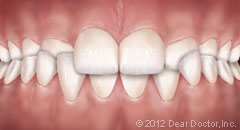
One is severe crossbite, a condition where the upper teeth close inside the lower teeth. To treat this problem, a device called a palatal expander can be used, which gradually and painlessly widens the upper jaw; it's especially effective when the jaw itself hasn't fully developed. If we wait too long, a more complicated treatment — or even oral surgery — might be required to correct the problem.
Crowded Teeth
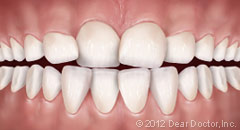
Another condition that may benefit from early treatment is severe crowding. This occurs when the jaws are too small to accommodate all of the permanent teeth. Either palatal expansion or tooth extraction may be recommended at this point, to help the adult teeth erupt (emerge from below the gums) properly. Even if braces are required later, the treatment time will likely be shorter and less complicated.
Protruding Teeth
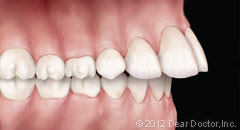
Early intervention may also be helpful in resolving several other problems. Protruding teeth, especially in front, can be prone to chipping and fractures; they may also lead to problems with a child's self-image. A severe underbite, caused by the lower jaw growing much larger than the upper jaw, can result in serious bite problems. Orthodontic appliances, including braces and headgear, can be successfully used to correct these problems at this stage, when the child's development is in full swing, thereby increasing the chances that surgery can be avoided.
Bad Habits and How They Influence Early Tooth Development
At one time or another, anyone may pick up a bad habit. But there are some situations where a youngster's parafunctional (detrimental to health) habits can actually influence the development and function of his or her teeth, jaws and mouth. Some examples of these are persistent thumb sucking, tongue thrusting, and mouth breathing.
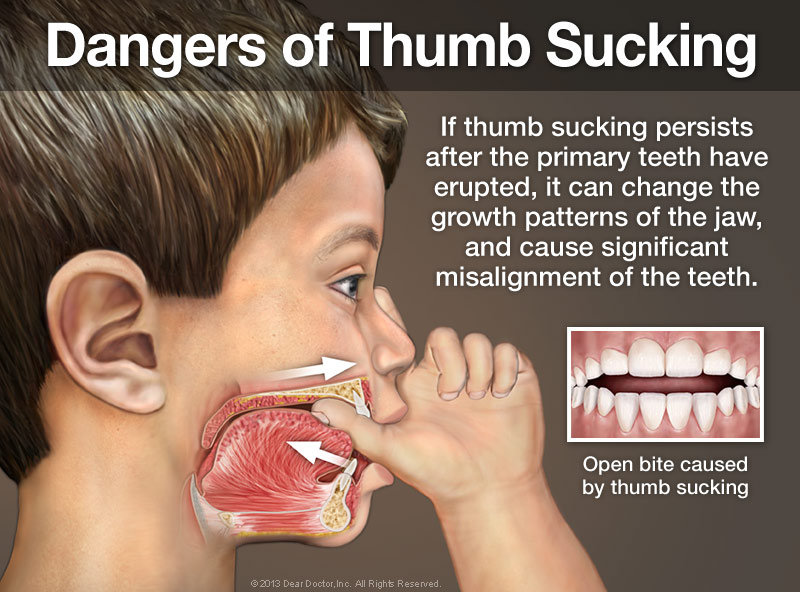
Thumb Sucking
The sucking reflex is natural in early childhood; it usually disappears between ages 2 and 4. But if it persists much later, the pressure of the digit on the front teeth and the upper jaw can actually cause the teeth to move apart and the jaws to change shape. This can lead to the orthodontic problem called "open bite," and may impair speech. An open bite can also be caused by the force of the tongue pushing forward against the teeth (tongue thrusting).
Mouth Breathing
An abnormal breathing pattern in which the mouth always remains open, passing air directly to the lungs — is related to alterations in the muscular function of the tongue and face. It may cause the upper and lower jaw to grow abnormally, which can lead to serious orthodontic problems. Although mouth breathing may start from a physical difficulty, it can become a habitual action that's hard to break.
Correcting Bad Habits
Various orthodontic treatments are available to help correct these parafunctional habits — and the sooner they're taken care of, the less damage they may cause. But these potential problems aren't always easy to recognize. That's one more reason why you should bring your child in for an early orthodontic screening.
Dr. Jeri Stull Orthodontics Reviews
Dr. Stull's office has taken great care of my daughter, and continues to do so. They are caring and nice and easy to talk to.
Dr. Stull is a wonderful orthodontist and always supports our local community/schools with donations. The staff are so professional. Visits are efficient and easy. My daughter never complains about going (Dip and Dots may help).
I would recommend them to everyone! They are amazing!!!! Thank you for all your hard work and dedication!!
I’m beyond thankful to Dr. Stull and her staff for putting my nerves to rest at my first appointment. I was not sure what could be done for my mature teeth but they came up with a game plan and I’m super excited to get started. I guess you are never too old to get your smile right!
The service here is amazing. Every worker does an amazing job each and every day to help my teeth. And Dip N Dots after each visit is amazing! -Ava 10y/o patient
330
Total Reviews
5
Star Average Rating

